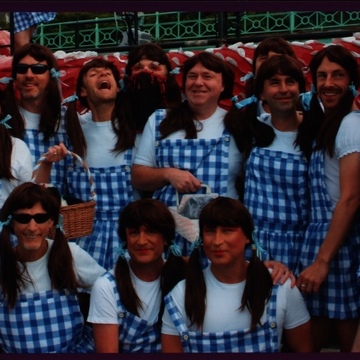
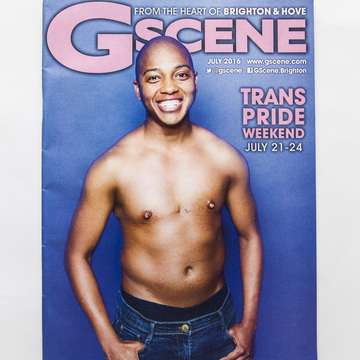
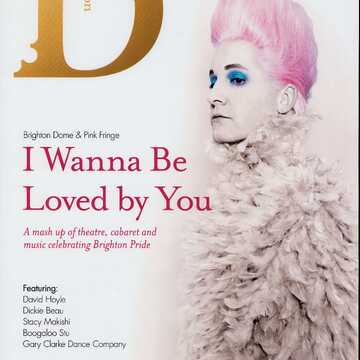

When we used 5000 red cupcakes to create a 40 foot slipper and 40+ matching gingham dresses. Amazing reaction from thousands of people in the audience. Great sense of community and unity.
Using three symbolic and evocative objects, Fox Fisher shares personal and political stories of their queer life in Brighton over the last two decades.
Artist, film maker, author and trans campaigner, Fox Fisher is a local and national mover and shaker, their advocacy work has and continues to inspire and empower trans and queer people around the world.
In this interview Fox talks about being a young student at Brighton university, about the origins of Trans Pride, and about their political commitment and activism from public to private life.
Recorded remotely on August 27, 2021
Interview by: Roni Guetta and David Sheppeard
Editing and original music by Olive Mondegreen
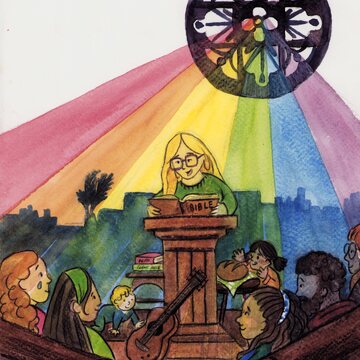
This watercolour painting was done in response to attending One Church Brighton, which is very inclusive of LGBT+ people, with services about Queer Theology and Pride Communions. This painting shows how the unconditional love and acceptance of God mirrors that of the LGBT+ community. Despite how much the church has rejected gay people, some at One Church find it a place to heal.
Created in May 2025
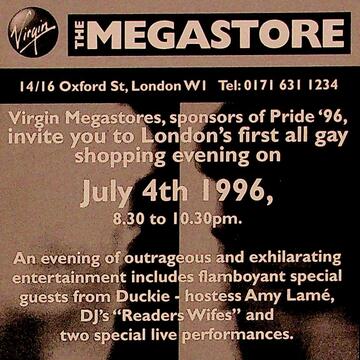
Flyer advertising Gay Shopper's event at The Megastore with live performances and entertainment.
July 4th 1996 at 14-16 Oxford Street, London W1.
Hosted by Duckie's Amy Lame and the Readers Wifes.
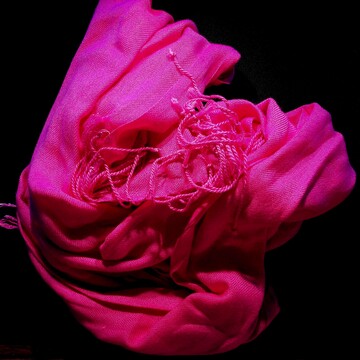
Pink Kashmir scarf with fringe.
A gift from a friend who shared a similar cultural background to myself where you could not always admit you were different but wanted to be able show your identity in a way that was important to you. We both knew Pink was a colour that was associated with PRIDE and it was she who gave me the scarf to tell my story but hidden in plain sight.
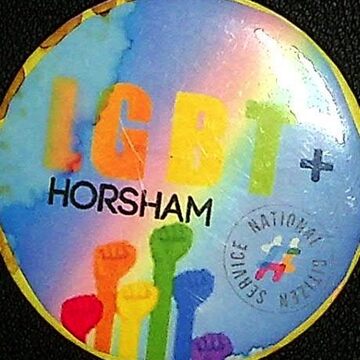
A badge handed out at the first Horsham Pride event in 2017, run by students involved in the National Citizenship Service. The pride event ended up being about 20 teenagers sitting in a park wearing flags.
Elle Kennedy is interviewed by Ten Harber. She speaks about coming to Brighton for university in 2010 and choosing it as a place to transition. She speaks about nightclubs such as Legends, The Queens Arms and Revenge, and the issue of unisex toilets in club spaces. She speaks further about passing and dating as a transwoman, including the challenges of being translesbian in women’s spaces.
Elle also talks about straight people attending Pride and how it brings a higher security risk. The Clare Project is mentioned as a space to meet and speak to other trans women, also noting The Marlborough and The Zone as trans-friendly spaces. Though self-identifying as right of Labour, she does support Caroline Lucas and the Green party in Brighton.
Brighton is mentioned as a place that introduced Elle to gender beyond the binary, now regarding the term queer as a ‘conciousness’ rather than as a sexual preference.
Elle speaks about transitioning and how Brighton uniquely helped with that.
"Interview with John Rosewarn for Queer in Brighton Oral History Project (28 May 2013), interviewed by ??.
Oral history interview collected as part of the Queer in Brighton project 2013-2014. Life history from Taunton to Brighton DOB 1944 circa - leaves home at 18 (gets thrown out by father after being caught in bed with dad’s best mate) goes to London -sex worker from 18 to 24 years of age 1961 to 1967 - moves to Brighton 1969. Trains as a nurse - lives in Brighton- work students in Hayward’s Heath. Moves to Spain from 1991-1999. Talks about sex work, cottaging and it’s demise in the early 1980s, celebrities, work as a nurse, homophobia, bars in Brighton, his relationship with older man - open relationship- promiscuity, first Pride, estrangement from parents, drag persona. "
Roni is interviewed by Ten Harber. Roni moved to Brighton in 2009 from Rome after previously visiting Brighton Pride. She speaks about the origin of Tramfrau as a response to Brighton’s nightlife being primarily geared towards students. She talks about how an activity space was included in the event to encourage interaction and socialising beyond the dancefloor. She talks about the risks taken to include different types of performance and music and how that has been unappreciated or misunderstood. Feedback is an important part of the process and has shaped how this event has changed over time.
As the night became more successful it moved to a larger venue and some measures were taken to counteract antisocial behaviour, such as through the marketing of the event as well as featuring politics as part of the decor. She speaks further about the sensitivities around the language used to describe and conceptualise the night and how this has evolved alongside the event itself.
Rory Smith is interviewed by David Sheppeard in The Marlborough theatre green room. Rory came to Brighton in 2001 when he was 18 for university. He speaks about other close family members coming out to him before he came out as bisexual, and how it wasn’t until his third year of university that he discovered LGBT nightlife in Brighton. He speaks about being intimidated by the lesbian scene in the mid-2000s and how starting a drag king troupe helped him explore his gender identity. Whilst working for a trans charity he began to be solely referred to as Rory and use he/him pronouns. He speaks about bi erasure in Brighton and how it has been even more of a challenge post-transition
Rory talks about being part of the group that started the Club Wotever events at The West Hill, which was one of the only alternative queer events at the time. The Cowley Club is also mentioned as part of this scene and it’s involvement with Queer Mutiny, an activist group. Rory then became involved in FTM Brighton and notes how a Trans Day of Remembrance became the catalyst for a new wave of local trans activism, including Trans Pride.
Latex Theatre was initiated as part of a sexual health project, in Leeds, in the early 90s. The group met weekly in the AIDS Advice Centre, and wrote collectively and individually.
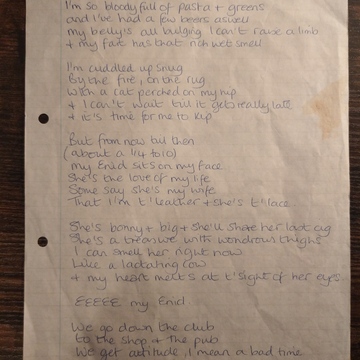
1. A manuscript of a poem that Janet co-wrote in 1994 with her partner. The poem was read and performed on tour across the country.
2. A photograph of Janet and another member of Latex theatre performing a short piece at London Pride between 1993 and 1995.
The piece was short and punchy and delivered in an angry tone. Each of the sentences was made from tabloid newspaper headlines, and the homophobic language used around HIV/AIDS.
"AIDS, you're better off dead.
AIDS, a bullet in the head.
AIDS, you made your bed, lay on it"
3. Stupid Bastard: a sketch written by Janet Jones for Latex Theatre in 1993. The piece is a commentary on current legislation on AIDS, rape, MSM, the prison population, the age of consent, and drug use.
Brighton Lesbian and Gay Pride, 15-25 May 1992, was organised by a small group of people under the name of Pink Parasol. In the run up to the event they produced a leaflet about their plans for Pride, which included the unveiling of a Lesbian & Gay Pride Memorial in the Old Steine. The leaflet announced the unveiling on Sunday 17 May 1992, and made it sound very much like it was a done deal with the council.
"Brighton Council has pledged a central site on the Old Steine and has agreed to install and maintain the memorial. The granite slabs from which it is to be made are ready for work to begin. The design and wording has been consulted on and approved.
"The memorial is a celebration of our Pride over the last quarter of a century. It is dedicated to the lives of ordinary lesbians and gay men who preceded us, to ourselves, and to the future equality of those who will follow us in this life".
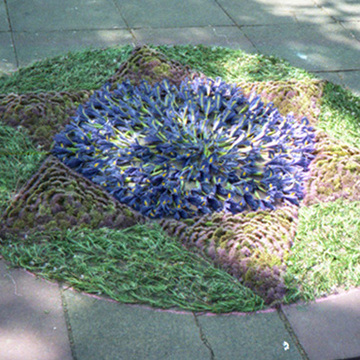
When a group of us gathered to attend the unveiling, we were surprised so see there was only a chalk outline of the memorial drawn on the ground, with the design beautifully brought to life with flowers.
According to a news report in Capital Gay by Richard Smith, the council rejected the proposal very late in the day. One of the objections raised was that the Pride memorial was too close to the existing war memorial. Sadly the Pride Memorial was never realised in anything more than flowers.