
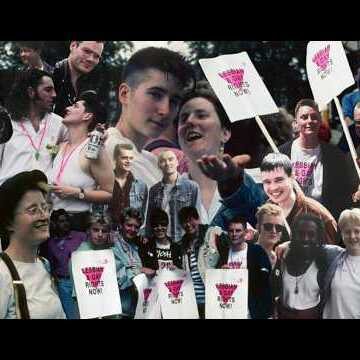

Abigail Dombey in conversation with Kate Wildblood, reflecting on queer life on Brighton during 1989-1992 and the community created through protest and Pride courtesy of the discovery of Abigail’s long lost slide film collection.
From her job in the local camera shop to the streets of Brighton, Abigail Dombey, a budding 18-year-old queer reportage photographer, was capturing the passion and the prejudice of early 1990s Brighton, one 35mm slide film at a time.
A time where bigotry and fear stalked the LGBTQ+ community as they fought against the Tories’ hateful Section 28 legislation, the media’s toxic narrative and society’s demonisation of queer lives at a time of the HIV and AIDS pandemic. A time of Doc Marten’s pounding the streets in protest, placards held high, hearts full of the desire for action (and occasionally each other). A time of grassroots activism as the shame fuelled by Section 28 loomed large over our lives, homophobic violence a daily reality, challenging our sense of LGBTQ+ community as we fought to create our modern day Pride movement.
It was our time, of baby dykes and glorious queers, of prejudice, protests and those all-important picnics. A time that saw us determined to challenge the unremitting homophobia that filled our lives and change the world together. One protest t-shirt at a time.
History isn't just in the past; it's in the present. All the steps and moments we take as a community lead to radical changes. We invite you to bring photos or look through your memories of what's in Brighton and is making history. We will have a map of Brighton to gather around and discuss what makes Brighton the place for you.
Queer Heritage South; powered by Marlborough Productions. Made possible thanks to The National Lottery Heritage Fund.
Filmed by Lucy Lebrocq
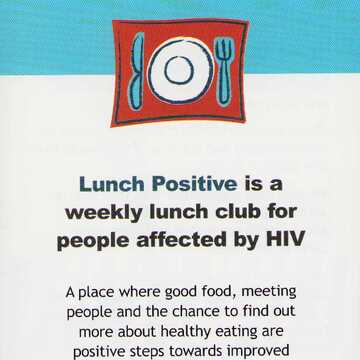
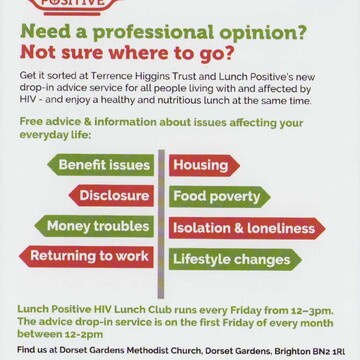
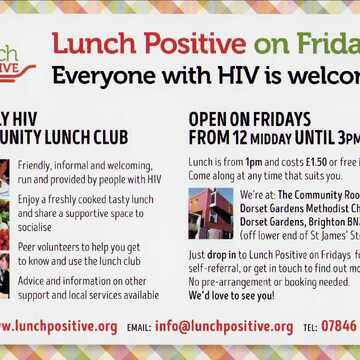
Flyer advertising Lunch Positive, a weekly social group for people living with HIV in Brighton. Meetings were held every Friday in Dorset Gardens Methodist Church and involved sharing lunch and meeting and supporting other people with HIV.
Lunch Positive was established in 2009 as a weekly lunch club for people living with HIV and their carers. It provides a welcoming space where good food, meeting people and the chance to find out more about healthy eating are positive steps towards improved well-being.
The club meets every Friday from 12 noon to 2.30 pm, with lunch served from 1 pm at the Community Hall, Dorset Gardens Methodist Church.
Get it sorted at Terrence Higgins Trust and Lunch Positive's new drop-in advice service for all people living with and affected by HIV, and enjoy a healthy and nutritious lunch at the same time.
Free advice and information about issues affecting daily life, including benefit issues, housing, disclosure, food poverty, money troubles, isolation & loneliness, returning to work, lifestyle changes.
Lunch Positive HIV Lunch Club runs every Friday from 12–3 pm. The advice drop-in service is on the first Friday of every month between 12–2 pm.
Weekly HIV community lunch club opens on Fridays from 12 midday until 3 pm. Lunch is from 1 pm and costs £1.50, or is free if needed. Come along at any time that suits you.
Lunch Positive provides HIV community support, including: Friday Lunch Club and Drop-in, Monthly Supper Group, Befriending & Buddying, Positive Times Wellbeing Programme, Eastbourne & Hastings Social Groups, Women's Group, Walk & Talk Therapy, Volunteering, Pantry & Food Bank, Home Outreach.
On the 3 May 2024 Stuart from The AIDS Memorial (Instagram) contacted me to say that a photo of my dear friend Andrea Philippe Regard would be featured in the ‘Live to Tell’ segment of Madonna’s ‘Celebration’ concert being held in Rio on 5 May.
The Aids Memorial was a direct inspiration for the Brighton AIDS Memorial, so Andrea’s inclusion in the show in his home country was both a wonderful surprise and an honour. Andrea loved Madonna and when we chatted in my café, ‘The Immaculate Collection’ was often played – it sound-tracked the last months of his life.
Stuart who lives in Scotland started The AIDS Memorial account on Instagram in April 2016. Every day, those who’ve died from AIDS are remembered via pictures and words from the people who knew and loved them, as well as first-person accounts from those who are long-term survivors of HIV and AIDS.
Thank you Stuart for your inspiration and kindness. Big love Harry x
The Martin Fisher Foundation is a partnership of people living with HIV, community representatives & clinicians. The charity's aim is to end the HIV epidemic and eliminate HIV stigma by 2030.
With effective treatment, HIV is like any other long- term medical condition. One tablet a day can suppress the virus and stop it from being passed on.
People diagnosed early with HIV and started on treatment can remain fit and well, and live as long as anyone else.
The celebration and launch of the Martin Fisher Foundation takes place on 14th September 2015, 14:00–16:15 at Brighton Dome. To include a tribute film, Towards Zero, a call to action led by Baroness Gould and Professor Jane Anderson, personal pledges and music. 16:15–18:00: opportunity for meeting old and new friends at the foyer bar.
Informative leaflet distributed by the NHS about masturbation, including the perception of masturbation in wider society, common myths, and benefits of masturbation including how it can be utilised in the practice of safer sex.
The leaflet aims to inform readers about masturbation and destigmatise and reduce shame around the practice.
Published in September 2011 by the Centre for HIV and Sexual Health which is a part of Sheffield Teaching Hospitals.
Maurice’s story - 19 December 1987
‘I developed swellings in my glands and my bowel movements became difficult. I told my doctor, whose reaction was “glands, that’s nothing - feel mine. I hope you’re not becoming obsessed with your bowels.” I was sent for a blood test, but as there was no HIV test in 1982, I was told that I must have picked up a virus which had now gone. But I think that it could have been HIV as two years ago I was diagnosed as being antibody positive. Since that day, I have to thank the Sussex AIDS Helpline, from whom I had support from the first moment of the shock of my diagnosis. I very soon joined the Helpline myself - it was the only way I could cope with everything. I had to know as much as I could about AIDS. After a while I realised I wanted to work with people with AIDS, so I did a course in massage techniques, so I could offer something useful to the people I worked with.
Because I have had a full life, I can’t be too sad, though I’m not ready to go yet and I’m going to put up a fight. The people I feel sorry for are the young ones who thought they had a full life to lead, and now live in fear and doubt.
Today at St. Peter’s Church, I witnessed the most beautiful service of my life – a memorial to those in Sussex who have died of AIDS. Bless whoever in the Helpline who first thought of this. I shall remember it for the rest of my life, however long that might be, and I shall remember my departed friends.’
Maurice died on the 12 January 1988, quite suddenly but peacefully.
National AIDS Memorial Quilt
On the 14 March 1992, Our House Body Positive & Pink Parasol held their first support group to encourage Brighton contributions to the National AIDS Memorial quilt at the Morley Street Family Centre. At this first session the film ‘Common Threads – Stories from the Quilt’ was shown, and this inspired me to create a quilt panel for my friend Andrea Philippe Regard.
A series of exhibitions of the completed 6’ x 3’ panels celebrating the lives of people who died was arranged as part of the 1992 Brighton Lesbian and Gay Pride. On the 17th May (then known as Lesbian & Gay Remembrance Day - now International Day Against Homophobia, Biphobia and Transphobia) some of the quilt panels were displayed in the Brighton Museum, and then between the 19th and 21st May the whole National AIDS Memorial Quilt was laid out at the Holy Trinity Church, Ship Street - now the home of the Fabrica Gallery.
The quilt which my ex-partner Alf Le Flohic and his friend John Twoomey helped me to make, was also displayed at the Brighton Gay and Lesbian Pride celebration in Preston Park that year.
Brighton Cares newsletter, July 2000. Contains details of productions, news from the Grants Secretary, examples of thank you letters to Brighton Cares for grants awarded, and a thank you to supporters.
Newspaper clipping from January 31st 1991 with headline 'Has Mayor backed down over AIDS?' The article includes how Hove Mayor Francois Dupre who once accused many AIDS victims of being hell-bent is now supporting a major funding campaign. It also includes a section about Brighton Cares which raised money to help people living with HIV/ AIDS