National AIDS Memorial Quilt
On the 14 March 1992, Our House Body Positive & Pink Parasol held their first support group to encourage Brighton contributions to the National AIDS Memorial quilt at the Morley Street Family Centre. At this first session the film ‘Common Threads – Stories from the Quilt’ was shown, and this inspired me to create a quilt panel for my friend Andrea Philippe Regard.
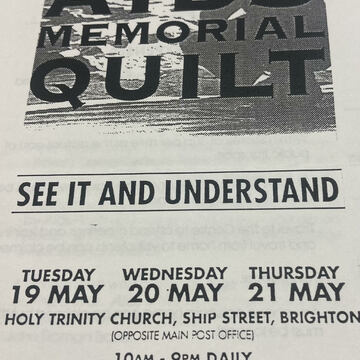
A series of exhibitions of the completed 6’ x 3’ panels celebrating the lives of people who died was arranged as part of the 1992 Brighton Lesbian and Gay Pride. On the 17th May (then known as Lesbian & Gay Remembrance Day - now International Day Against Homophobia, Biphobia and Transphobia) some of the quilt panels were displayed in the Brighton Museum, and then between the 19th and 21st May the whole National AIDS Memorial Quilt was laid out at the Holy Trinity Church, Ship Street - now the home of the Fabrica Gallery.
The quilt which my ex-partner Alf Le Flohic and his friend John Twoomey helped me to make, was also displayed at the Brighton Gay and Lesbian Pride celebration in Preston Park that year.
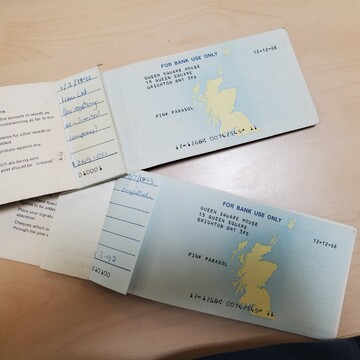
Pride 1992 was organised by a short-lived committee: Pink Parasol. The cheque stubs show its first and last payments, just a year apart. Wisely, Pink Parasol decided to register as a limited company, thus protecting its members from being held personally liable for the debts that remained after the Pride event was over.
Pink Parasol was an attempt to broaden the appeal of Pride beyond the radical activists (including me) who had organised the first Pride weekend in 1991. It included some business people and, if I recall correctly, someone from the Metropolitan Community Church. But the commercial gay scene never really got involved and didn’t invest any substantial funds into the event.
The committee also included some people with big ideas and grand plans. More and more attractions were booked for the march’s arrival in Preston Park – a stage, a funfair, numerous food and drink vendors, even fireworks! Tragically, we had gambled that the crowd would be bigger, and would spend more freely, than proved to be the case on the day.
As treasurer, already aware of how badly things were heading into the red, I spent the afternoon attempting to extract the promised fees from disgruntled stallholders. As the day ended with a moving performance from Labi Siffre and a spectacular firework display, I remember feeling decidedly sick with dread.
Somehow, all the big ideas people melted away and it was left to me and one other woman to close down the company and sign all the letters to our creditors explaining that we could only pay them 15% of what we owed them. Just as Pride was getting started, this was a major setback. But we picked up the pieces and moved on.
These chequebooks are deposited at The Keep (East Sussex and Brighton and Hove Record Office), as part of the Ourstory archive (Papers of Dani Ahrens, OUR 37/1/2).